
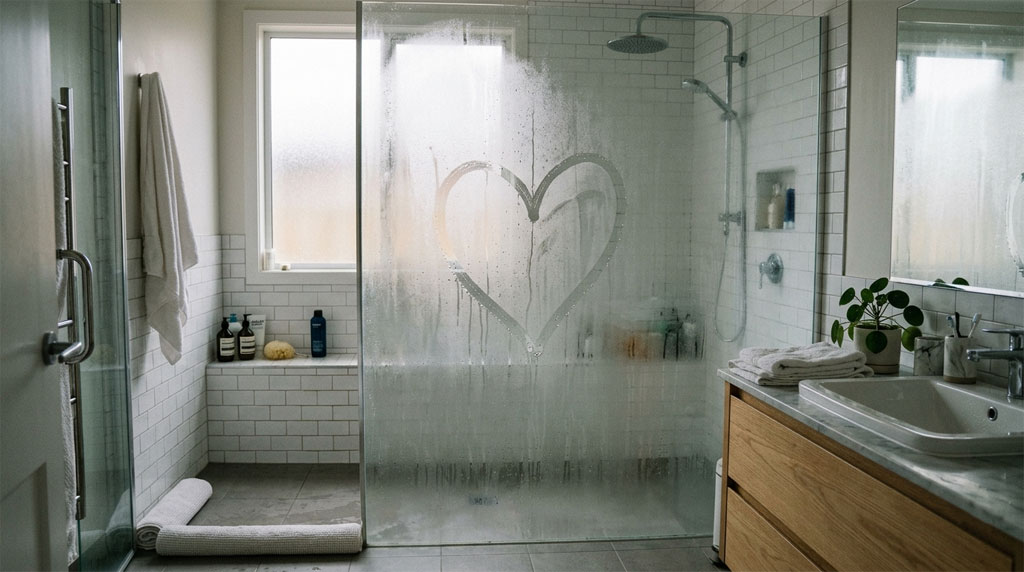
As a kid, I was constantly reminded by my mother to turn on the bathroom fan when I showered. I never thought about the steam I was producing; I just liked drawing on the condensation on the mirror.
Now that I’m a homeowner myself, I’ve become my mother. I don’t like condensation. I can feel the damp in my bones.
Until last month, I thought I was doing my part by turning on the extractor fan and heater every time I took a bath. Surely a fan AND heater was enough to keep my bathroom dry – wasn’t it?
Then I watched “The Hidden Moisture Problem in Our Homes,” the new show produced by Energy Efficient Homes.
The Hidden Moisture Problem in Your Bathroom
In it, Robert demolishes the idea that extractor fans are enough.
He uses the example of pouring beer from a keg. If you just have one hole, the liquid won’t flow. For movement, you need an entry point and an exit point.
With bathrooms, the extractor fan gives you an exit point. But where is the entry point? If you haven’t opened a window to allow fresh air in, you have none. Your fan is whirring, but the air isn’t stirring.
But wait, I thought. It’s winter. I’m not opening a window – I’ll freeze! So I turn on a fan heater. Surely my heater will create air movement.
But that’s like saying that swirling the liquid inside a keg will help it flow when it’s still only got one hole.
What a fan heater does is warm the air up, and warm air holds more moisture than cold air. So the steam doesn’t vanish; it just stays invisible instead of fogging up the mirror.
Not to mention the fact that I turn the heater off when I leave the bathroom, leaving that moisture with no escape except through my walls and ceiling.
The solution?
Either retrofit my old villa with a proper ventilation system – or open the window and let freezing air in.
Why an Extractor Fan May Not Be Enough
These are the sorts of challenges that energy-efficient building is designed to address. A high-performance home needs to solve two problems simultaneously:
“How do I get damp, stuffy air out?”
and…
“How do I avoid losing all my heat while doing it?”
There are three ways most homes tackle this.
Solution #1: Extractor Ventilation
Many older homes in Canterbury rely on extractor fans in the bathroom and kitchen to remove the worst of the moisture.
But that means someone has to remember to turn on a fan – and leave it on long enough.
It also leaves other sources of damp – such as breathing all night, or the condensation created by a cold outside and warm inside – untouched.
Solution #2: Mechanical Ventilation
Some newer houses have mechanical ventilation systems built in.
These supply fresh air to bedrooms and living areas while extracting damp air from bathrooms and kitchens, creating a planned airflow through the house.
Mechanical ventilation systems are much better than extractor fans. But they only help with ventilation; they don’t help with losing heat.
Solution #3: Heat-recovery ventilation
Heat-recovery ventilation adds another step.
You still have the same basic airflow pattern, with fresh air flowing into living spaces and damp/stuffy air leaving bathrooms and kitchens.
But before that damp/stuffy air exits the house, the system passes it through a heat exchanger.
The outgoing and incoming air streams pass close to one another without mixing. Heat from the outgoing indoor air is transferred to the incoming outdoor air.
So, in winter, instead of doing this:
Warm indoor air → outside
Cold outdoor air → inside
you get:
Warm stuffy indoor air → heat exchanger → outside
Cold outdoor air → heat exchanger → warmed fresh air → inside
Although heat-recovery ventilation won’t heat your home, it retains much of the heat that would otherwise be lost when you ventilate.
How An Unheated Bedroom Stays Warm Overnight
This explains why our founder Robert Whitehouse’s energy-efficient home drops only one degree overnight, even though he turns his heating off.
I’m envious. On our recent below-freezing mornings, I’ve woken up early from the cold. I grab a towel to dry the windows. This old villa just isn’t energy efficient.
Were I in the market for a new build, a heat-recovery ventilation system would be on my wish list. It solves the problem of:
“How do I get damp, stuffy air out?” and
“How do I avoid losing all my heat while doing it?”
And it solves this problem without any action on your part. You never have to remember to turn on the fan. You don’t have to remember to open a window. The house takes care of the ventilation for you.
To find out how an energy efficient home could make your life easier, get in touch.